Friday, October 19, 2012

LGBT History Month: Kenneth Weishuhn


Image Source

Kenneth Weishuhn of Primghar, Iowa was just 14 years old when he came out to his classmates this past March.  Born May 27, 1997 in Sheldon, Iowa, he was a happy teen, a freshman at Paullina's South O'Brien High School.  His sister Kayla was his best friend.  He liked video games and rollerblading, and he played soccer for a local team.

After he told people he was gay he began to get bullied.  He asked his mother not to talk to the administration. "Mom, you don't know how it feels to be hated," he said.  People who were his friends turned on him; he was teased in school; and someone even created a Facebook hate group against LGBT people and added his friends.

Then came the death threats.  Students from his school would call his cell phone and leave threatening voicemails, saying he didn't deserve to live, God hates fags.  He blew them off in front of his family, but on April 15, 2012, Weishuhn killed himself.  Another tragedy of someone not being heard, another shining life lost.

~~

Also this month:

~ October is also National Bullying Prevention Month.

~ October 10th was Unity Day; wear orange to show your support and remind others about the importance of bullying prevention.

~ October 11th was National Coming Out Day when we celebrate coming out as gay, lesbian, bisexual, transgender or as an ally. See the Human Rights Campaign website for resources on coming out.

~ October 19th is Spirit Day; wear purple on this day to support LGBT youth & stand up against bullying.

Thursday, October 18, 2012

LGBT History Month: Spirit Day


Image Source

In October 2010, Brittany McMillan urged her friends to wear purple in memory of the LGBT youth who were the victims of bullying and had committed suicide. She called it Spirit Day after the purple stripe in the Rainbow Flag designed by Gilbert Baker which stands for spirit.  The Gay & Lesbian Alliance Against Defamation (GLAAD) added their voice to McMillan's and on October 20, 2010, people all over wore purple, including celebrities such as Ryan Seacrest, Jenna Ushkowitz and the cast of Glee, and Secretary of State Hillary Clinton.  Since then Spirit Day has become a global movement with millions of people participating.

Why wear purple?
  • One in four students from elementary through high school have reported being bullied at school because of their race, ethnicity, gender, religion, sexual orientation, or disability.
  • Six in 10 US teens witness bullying at least once a day.
  • More than 91% of LGBT students say they hear homophobic slurs frequently (as often as 26 times a day) and faculty intervenes about 3% of the time.
  • Teen students (straight and LGBT) say the worst harassment is to be called gay or lesbian.
  • 27% of LGBT students report having been physically hurt by another student.
  • LGBT students are five times more likely to skip school because they don't feel safe; more than 64% say they don't feel safe.
  • LGBT youth are two to six times more likely to attempt suicide, and 30% of all suicides are related to sexual identity.
  • Suicide is the leading cause of death among LGBT youth.

  • And perhaps most important of all:
  • In a typical class of 30 students, eight students (27%) will be directly affected by homosexuality, either their own, one or more siblings, or one or both parents.


~~

Also this month:

~ October is also National Bullying Prevention Month.

~ October 10th was Unity Day; wear orange to show your support and remind others about the importance of bullying prevention.

~ October 11th was National Coming Out Day when we celebrate coming out as gay, lesbian, bisexual, transgender or as an ally. See the Human Rights Campaign website for resources on coming out.

~ October 19th is Spirit Day; wear purple on this day to support LGBT youth & stand up against bullying.

Wednesday, October 17, 2012

LGBT History Month: Billy Lucas


Image Source

Billy Lucas was born and raised in Florida, where he was a talented equestrian with many friends.  His family moved to Indiana when he was in the fourth grade, and he started to be teased.  He didn't play sports; his skin was darker (he was part Indian, part Asian); he had a learning disability; and his classmates thought he was gay.  He would come home with bruises and stories of being kicked and hit, and each year his mother would go and talk to the schools, but the bullying didn't stop.

After 5 years, he had had enough.  On Sept. 9, 2010, Lucas hung himself in his grandmother's barn.  Just days before he did so, he told his mother, "Mom, you don’t know what it’s like to walk down the halls of school and be afraid of who’s going to hit you, who’s going to kick you.”  Lucas' suicide was the first to be widely reported and prompted the start of the "It Gets Better" campaign.  Dan Savage, co-founder (with his husband, Terry Miller) of the project, wrote, ""I wish I could have talked to this kid for five minutes. I wish I could have told Billy that it gets better. I wish I could have told him that, however bad things were, however isolated and alone he was, it gets better."

Within months the "It Gets Better Project" had inspired more than 10,000 YouTube videos and had over 30 million views.  Anti-bullying campaigns have been started in schools across the nation, there has been a National Summit on Bullying, and the White House held the first conference on bullying prevention.  Lucas' family has filed a wrongful death suit against the school and four of its employees, claiming they not only knew about the bullying and did nothing to prevent it, but on occasion were part of it.

~~

Also this month:

~ October is also National Bullying Prevention Month.

~ October 10th was Unity Day; wear orange to show your support and remind others about the importance of bullying prevention.

~ October 11th was National Coming Out Day when we celebrate coming out as gay, lesbian, bisexual, transgender or as an ally. See the Human Rights Campaign website for resources on coming out.

~ October 19th is Spirit Day; wear purple on this day to support LGBT youth & stand up against bullying.

Tuesday, October 16, 2012

LGBT History Month: Tyler Clementi


Image Source

Tyler Clementi was born December 19, 1991; less than 3 months before his 19th birthday, on September 22, 2010, he took his life by jumping off the George Washington Bridge.  Clementi was a talented violinist, playing with the Ridgewood Symphony Orchestra in New Jersey and serving as concertmaster in the Bergen Youth Orchestra.  He was attending college at Rutgers University.

Clementi had just come out as gay to his parents shortly before leaving for college.  Although his mother had mixed feelings, both parents were supportive, and his mother even described him as confident and comfortable.  But an incident with his new roommate, Dharun Ravi, and a fellow hallmate, Molly Wei, left him more than uncomfortable.

Clementi had requested the use of their room the evenings of September 19th & 21st.  Ravi left the room the first evening, but turned his webcam to Clementi's side of the room and left his computer so he could access it remotely.  Which is what he did from Wei's room, long enough to see Clementi and his guest kissing.  Later, Wei turned the camera back on with others in the room, though Ravi wasn't there. This time they saw the two young men kissing with no shirts, but with their pants on.

The next day Clementi saw the twitter message that Ravi had sent just after the first viewing.  "Roommate asked for the room till midnight. I went into molly's room and turned on my webcam. I saw him making out with a dude. Yay."  It was then that Clementi first requested a new room because his roommate was using a webcam to spy on him.

The evening of the 21st, Ravi sent another tweet, inviting people to watch his webcam while he was out of the room that night.  He said later he had put his computer in sleep mode so the camera would be disabled, but Clementi saw the camera turned toward his bed and unplugged it.  He reported the incidents to his resident assistant (RA) and 2 other Rutger's employees, requesting not just a room change but also a punishment for Ravi, stating, "I feel that my privacy has been violated and I am extremely uncomfortable sharing a room with someone who would act in this wildly inappropriate manner."

Clementi wrote several online posts in forums about the incidents and his last sounded hopeful that the RA was taking it seriously.  However, at 8:42 pm on the night of September 22nd, Tyler Clementi posted from his cell phone to Facebook, "Jumping off the gw bridge sorry." His body was found September 29th in the Hudson River just north of the George Washington Bridge.

Tyler Clementi was just one of four teens who committed suicide after being teased or bullied for their homosexuality that month.  Tyler's parents created the Tyler Clementi Foundation, which "promotes safe, inclusive and respectful social, environments in homes, schools, campuses, churches and the digital world for LGBT youth and their allies."  Anti-bullying legislation was introduced at the state and federal levels. Brittany McMillan worked with GLAAD to create Spirit Day in memory of the young LGBT people who lost their lives to suicide.

Molly Wei took a plea bargain that in exchange for dismissing the charges she would testify against Ravi, serve 300 hours of community service, go to counseling for cyberbullying, and take classes on dealing with people of alternative lifestyles.  Dharun Ravi was convicted on all 15 charges and was sentenced to 30 days in jail, 3 years probation, 300 hours of community service, a $10,000 fine, counseling for cyberbullying, and classes on alternate lifestyles.

~~

Also this month:

~ October is also National Bullying Prevention Month.

~ October 10th was Unity Day; wear orange to show your support and remind others about the importance of bullying prevention.

~ October 11th was National Coming Out Day when we celebrate coming out as gay, lesbian, bisexual, transgender or as an ally. See the Human Rights Campaign website for resources on coming out.

~ October 19th is Spirit Day; wear purple on this day to support LGBT youth & stand up against bullying.

Monday, October 15, 2012

LGBT History Month: Matthew Sheppard


Image Source, edited by Diana *BunnyKissd* Bukowski

October 12, 1998, after five days in intensive care, Matthew Shepard succumbed to the beating he had received the night of October 6-7th.  He was only 21 years old.

Born December 1, 1976, in Casper, Wyoming, Sheppard went to school there until his senior year, when his father was hired to work in Dhahran, Saudi Arabia, and he went to school in Switzerland.  After graduation, he attended college at the University of Wyoming in Laramie, where at a bar he first met Aaron McKinney and Russell Henderson.

On the night of October 6th, Sheppard asked McKinney for a ride home.  The three boys got in the front seat of McKinney's pickup, with Henderson driving.  When Sheppard reached over and grabbed McKinney's leg, McKinney hit him with a gun.  He asked for Sheppard's wallet and money and even though he got it, he continued to beat him and told Henderson to drive him to a secluded area.

The two tied Sheppard to a split rail fence and McKinney continued to pistol whip him.  Henderson tried to stop him at one point, but was hit with the gun as well; so he went back to the truck leaving McKinney to give Sheppard what he feared were the fatal blows.  Then the two left the scene to get in another violent fight which led to their initial arrest.

But Sheppard wasn't dead.  Left to die, tied to the fence post, through the cold October night, it was 18 hours later when a cyclist rode by and mistook the comatose Sheppard for a scarecrow.  He was deemed too injured to operate on, and he was put on life support in in tensive care at Poudre Valley Hospital, in Fort Collins, Colorado where he died 5 days later at 12:53am.

Matthew Sheppard's story didn't end there though.  Although McKinney and Henderson went to jail for their crimes, they pleaded the gay panic defense, that they were driven to temporary insanity by Sheppard's alleged sexual advances, they they only planned to rob him, not kill him.  The brutality of Matthew's death led to requests that new legislation be passed that would identify attacks motivated by victim identity as hate crimes.

It took 11 years, but on October 28, 2009, President Obama signed the Matthew Sheppard Act into law, which "expands the 1969 United States federal hate-crime law to include crimes motivated by a victim's actual or perceived gender, sexual orientation, gender identity, or disability."

~~

Also this month:

~ October is also National Bullying Prevention Month.

~ October 10th was Unity Day; wear orange to show your support and remind others about the importance of bullying prevention.

~ October 11th was National Coming Out Day when we celebrate coming out as gay, lesbian, bisexual, transgender or as an ally. See the Human Rights Campaign website for resources on coming out.

~ October 19th is Spirit Day; wear purple on this day to support LGBT youth & stand up against bullying.

Sunday, October 14, 2012

LGBT History Month: National March on Washington for Lesbian and Gay Rights


Image Source, edited by Diana *BunnyKissd* Bukowski

On October 14, 1979, an estimated 75, 000 to 125,000 people marched on Washington to demand an “an end to all social, economic, judicial, and legal oppression of lesbian and gay people.”  It was the first of such marches and brought national attention to the gay movement which had previously only been a local struggle. There were Five Demands issued by the delegates:
  • Pass a comprehensive lesbian/gay rights bill in Congress
  • Issue a presidential executive order banning discrimination based on sexual orientation in the federal government, the military, and federally contracted private employment
  • Repeal all anti-lesbian/gay laws
  • End discrimination in lesbian-mother and gay-father custody cases
  • Protect lesbian and gay youth from any laws which are used to discriminate, oppress, and/or harass them in their homes, schools, jobs, and social environments
In addition to marching, there were three days of workshops with discussion groups, LGBT open houses, concerts, and more.  The Monday after the march was a day of lobbying when the participants successfully met with fifty senators and more than 150 house representatives to express support for gay-rights legislation.  Since this first National March on Washington for Lesbian and Gay Rights, there have been 4 marches: the Second National March on Washington for Lesbian and Gay Rights in 1987, the March on Washington for Lesbian, Gay and Bi Equal Rights and Liberation in 1993, the Millennium March on Washington in 2000, and the National Equality March in 2009.

~~

Also this month:

~ October is also National Bullying Prevention Month.

~ October 10th was Unity Day; wear orange to show your support and remind others about the importance of bullying prevention.

~ October 11th was National Coming Out Day when we celebrate coming out as gay, lesbian, bisexual, transgender or as an ally. See the Human Rights Campaign website for resources on coming out.

~ October 19th is Spirit Day; wear purple on this day to support LGBT youth & stand up against bullying.

Saturday, October 13, 2012

LGBT History Month: Symbols & their History

I was originally going to only write about the rainbow flag today, but realized that many people reading may not realize that our own rhinoceros mascot is also a symbol for the gay rights movement, and that there are other symbols used.  I have therefore pieced together a small guide of LGBT symbols, both popular and not so well-known.  I'll start with the most familiar symbol, the rainbow flag.


Image Source

The rainbow flag was originally designed in 1978 by Gilbert Baker, who dyed and sewed the fabric himself.  The flag originally had eight colored stripes, whose meaning is describe above, and was premiered at the San Francisco Gay and Lesbian Freedom Day Parade that year. The following year, Baker attempted to have it mass produced, but discovered that his original eight colors could not be used; the hot pink was removed, and the indigo was replaced by royal blue.  Following the assassination of Harvey Milk, the San Francisco Pride Committee chose the flag to honor Milk and opted to remove the turquoise so that the flag could be evenly divided on the street  along the parade route, with 3 colors on ones side and 3 on the other.  It is this six-colored flag that has spread across the nation and is universally known and recognized as a symbol of gay pride & diversity.


Image Source

Another well-known LGBT symbol is the pink triangle.  Assigned to male homosexual prisoners in concentration camps by the Nazis during World War II, the pink triangle began being used by the gay liberation movement in the 70s, but was truly reclaimed by the LGBT community in the 80s when ACT-UP (AIDS Coalition To Unleash Power) turned it right side up and adopted it as their symbol.


Image Source

The lambda symbol was not well-known to me until I began doing this research, but is one of the older LGBT symbols.  There are differing explanations for why the lambda was chosen and what it means, but most seem to agree that it was first chosen by the Gay Activists Alliance of New York in 1970, and later by the International Gay Rights Congress held in Edinburgh, Scotland.


Image Source

On October 31, 1969, the Gay Liberation Front and the Society for Individual Rights held a peaceful protest outside the offices of the San Francisco Examiner, which turned riotous when employees dumped purple printers ink on the crowd.  The protesters used the ink to graffiti the building and stamp purple hand prints throughout the city.  The tactic squad arrived, then brutalized and arrested the demonstrators rather than the employees who dumped the ink.  Inspired by the Mafia's Black Hand gangsters, some activists tried to use the "Purple Hand" as a warning symbol to stop attacks on the LGBT community, but it did not catch on.


Image Source

My favorite and the mascot for our own Queer Etsy Street Team, the purple rhinoceros was created by two gay rights activists in Boston as part of a media campaign to bring gay issues further into public view.  In December 1974 he made his debut in Boston subways, but the campaign soon became too expensive for the activists, and the ads disappeared before the rhino caught on anywhere.  Bernie Toal, one of the original creators, said, "The rhino is a much maligned and misunderstood animal and, in actuality, a gentle creature."  When angered however, it is a terrible beast and seemed a fitting symbol for the gay rights movement.  Lavender was used because it was a widely recognized gay pride color; the heart was added to represent love and the "common humanity of all people."

For more information on LGBT symbols, please check these sites:

~~

Also this month:

~ October is also National Bullying Prevention Month.

~ October 10th was Unity Day; wear orange to show your support and remind others about the importance of bullying prevention.

~ October 11th was National Coming Out Day when we celebrate coming out as gay, lesbian, bisexual, transgender or as an ally. See the Human Rights Campaign website for resources on coming out.

~ October 19th is Spirit Day; wear purple on this day to support LGBT youth & stand up against bullying.

October Challenge: Let Your Freak Flag Fly!

In honor of National LGBT History month, I've asked our crafty Queer Team members to show me their brightest & best, out & proud, LGBTQ stuff!  I think that the upcoming holiday rush led most members to pass on the challenge this time around, but we've got some lovely pieces!  Check these out:

All the colors of the rainbow shine on this little treasure...

Rainbow Bookmark Gay Pride Lesbian Swarovski Crystal Trophy Wife

from vee41dmb


Red is for life...

Blood Red Swarovski Crystal Heart Necklace

from Livingatnight


Orange for healing...

Singular Upcycled Gemstone Wine Charms. Green, Grey, White, Orange and Red. (set of 6)

from KarasLittleTreasures


Yellow, green, blue, and purple for sun, peace, art, and the spirit...

Flower Dangle Wine Charms with Swarovski Crystals. Green, Purple, Gold, Pink/Blue. (set of 4)

from KarasLittleTreasures


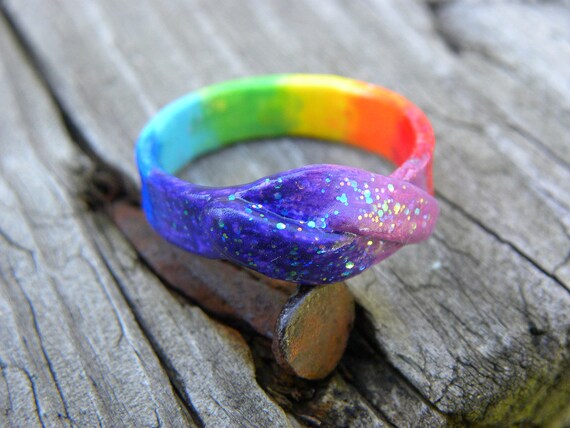
Wear this rainbow ring to let everyone know, whether queer or not, that you support LGBT rights!

Rainbow Twist Polymer Clay Ring

from FaerieGardenFancies

LGBT Back to School: How We Get That Way

This month the Queer Etsy Team is presenting our personal tales from school to offer hope for LGBT students returning to school with trepidation. May they learn from us that there is always someone out there who understands and supports them...  Today's story is written by Mariana Romo-Carmona and was originally published in Queer 13: Lesbian And Gay Writers Recall Seventh Grade.  Mariana creates & sells beautiful Chilean-style jewelry at Livingatnight on Etsy and you can read more about it at her blog, Livingatnight Chilean Arts.


Photo by Derek Visser

On some suburban street in central Connecticut, there must be a pink dogwood tree that is fully grown by now and opens every spring in beautiful blossoms of an inexpressibly, superbly pink, pink. I know this because in the spring of 1967 I walked to school every day and passed that tree. It had been a long, very snowy winter, and the little tree saved my soul when it bloomed.

At the very early hour of seven thirty, I passed that tree on the way to Alfred Plant Jr. High School. I usually walked alone because I was the new South American girl at school and I didn’t have many friends. In fact, I didn’t have any. The neatly trimmed lawns with sprouting crocuses and daffodils became familiar. The faux-Tudor facades and the brick and white clapboard houses with wraparound wooden porches and flower boxes all became part of what I learned to understand was suburban in that pretentious neighborhood. My own home was the middle floor apartment of a three-story wooden house on the main road, painted gray like its duplicate neighbors. I came to know that this is where the working class and the immigrant class lived, not in the smaller streets with the manicured gardens and nasturtiums by the hedge. Having no one to muse to about these things except myself, I did plenty of musing. Besides, after seven months my English was still somewhat flat and rudimentary. I couldn’t explain the finer points of the opinions I was forming. At least, the weather was improving and I was feeling a little less depressed.

My tree helped. It became my tree. It was not much taller than I was then, about five feet, and its dark brown branches bent in such poetic fashion-- small palms upturned, small hands dancing, I would sometimes sigh when I saw it. The blossoms opened and blushed so exquisitely that I would stop and gaze at the delicate arrangement with half-closed lids until I had drunk in all the tree’s beauty. My heart felt soothed after glimpsing my tree and I would march on to school where I would be the foreign girl again and nothing more for the rest of the day.

Once, though, one of the more tolerant girls in my class happened to be leaving her yellow and rust Victorianish house when I passed by and she didn’t make an excuse, such as having to get to home room early, so she walked to school with me. Her name was Andrea; she had curly brown hair and glasses. She could almost look like me, except she didn’t; she was clearly American and she kept to her tall, slightly goofy stride and nerdy New England patter. When we passed my tree, in a rush of budding adolescence and South American romanticism, I decided to confide in her.

“Look,” I said, gesturing poetically. “There is the tree I love.”

“Excuse me?”

“Oh, are you all right?” I asked, concerned that she may have hurt herself, or burped, and asked to be excused.

“No, I mean, what tree?” She shoved her horn rim glasses back up on the bridge of her nose.

“The small tree with the pink blossoms. It is so lovely, I am in love with this tree!”

“Oh.” Andrea looked around to make sure we had not been seen together. We hadn’t, so she quizzed me again. “What do you mean you are in love with the tree?”

“I love this tree because its beauty... upsets my heart so!” I explained, transported.

“Well, you can like a tree, that I can understand,” she said, as she resumed her pace up the street. “But you can’t be in love with it, that’s all!”

I don’t think that Andrea talked to me very much after that day. She was in practically all my classes, but whenever I saw her she adopted a kind yet pained expression and excused herself, as though she were a missionary and I an exuberant savage who might cause a scene with my unruly passions.

I got used to this way for things to be, for the rest of my high school years and into college. There was no way that I wasn’t going to be a little bit odd, wherever I was, and I realized years later that being an immigrant, usually the only Latina in any situation, was only part of the reason. I am sure that the episode with the pink dogwood expressed feelings that had already been stirring in my heart.


Photo from peregrine blue on flickr

Before we emigrated to the United States, my parents had gone to the north of Chile in search of better jobs. We left Santiago with its old streets and comfortable familiarity and moved to Calama, a small oasis town in the middle of the Atacama Desert. Everything was new there, the houses, the schools, the theater, and even the buses, which were clean and speedy without the spewing of ugly diesel we had to smell in the capital. The sky in Calama was always blue; it never rained, and some of its relative well-being seemed to have spilled over from the only nearby town, the copper mining Chuquicamata.

In Calama, I was enrolled in the only girls school, which was the norm in Chile. This one happened to be a Catholic one, run by Spanish nuns of the Dominican Order. There was a  co-ed public school, but when my very progressive parents had to choose between a secular education and one where I would be safe from adolescent boys, there was no question. And I certainly didn’t mind.

The code of behavior at the school was the same as in all girls’ schools, I imagine. That is how I had grown up, with women teachers and surrounded by girls like myself. So my new school provided me with something familiar, the same comfort that all Chilean girls had experienced before me, as had my mother and all her sisters. I wonder now how much of this is lost with the introduction of co-ed schools as a rule.

But the important development at this new school was that we were all entering the years of existential angst, of longing for the unfathomable reaches of love. We were sort of programmed to make our parents’ lives miserable. At least at school we had each other, we were very democratically in love with each other and sexual orientation had little to do with this.  Even though our devotion was unshakeable, we were growing up in the 1960's and most of us did imagine ourselves as starlets in Hollywood movies who would one day date one of the Beatles, preferably Paul.

I remember the day of my initiation. It was recess and I’d gone to stand by two girls sitting together on the sunniest part of the steps by the playground. This was the desert, but winter mornings were cool. Fatima was a beautiful girl with long black hair and shaded eyes from her luxurious eyelashes. I don’t think there was one of us who didn’t long to be her best friend. Next to her on the steps was María Eugenia who was the favorite of the nuns for being an orphan, or at least half an orphan because only her father was dead, and because she stayed in the school all the weekends, including holidays. As for me, I had nothing to recommend me; I was an ordinary Chilean girl.

Fatima and María Eugenia were playing at hiding María Eugenia’s gold chain within the folds of her shirt collar. Fatima had to find it with her fingers before her friend raised her shoulders and hid her neck in the collar of the uniform’s white shirt and navy blue sweater. Fatima’s fingers couldn’t reach far enough. They invited me to join them. María Eugenia winked at me with playful brown eyes, her lips in a teenage smirk all defiance and beckoning.

I sat with them on the steps, all three of us in navy blue pleated skirts, our legs gathered underneath sporting cinnamon colored knee socks, and of course, brown leather shoes with a spit shine. We played the game and soon gathered a crowd around us, the desert sky shining blue above. There was a lot of shoving and laughing, and within five minutes it seemed I had known those uniformed girls all my life. María Eugenia pulled up her chain and told me to try and get it-- it was a stupid game, I know, but how delicious.

It didn’t take long. I guess Fatima was tired of the game, so she let me try, draping her arm around me, instructing me on how to grab the chain before María Eugenia shrugged her shoulders and it slipped away. I placed my hands on María Eugenia’s shoulders and waited for her to let go of the chain. She was clearly enjoying the attention. “Ready?” she asked me, and dropped the chain down her neck and into the folds of her shirt. I dipped my fingers without shame around her collarbone and got hold of it. Her neck was warm.

Naturally, María Eugenia claimed I didn’t have hold of the chain, and Fatima and I maintained I had won fair and square, the three of us falling all over each other, tickling and slipping fingers around our mutual necks. The rest of the girls joined us in their own rough housing and loving embraces, until the nuns came to break it up and call us back into class. But María Eugenia and I had bonded for life.


Photo from Proctor Archives

Nothing like this easy and inclusive intimacy awaited me at Alfred Plant, and I’m sure I didn’t help matters by being a late arrival into the school year, and South American. I could have been tall, blonde, and French, but I had to be difficult.

Andrea wasn’t the only girl who was afraid of getting too close to me, especially after the dogwood incident. There was also Cherry, who played field hockey and thought she might have seen promise in my short Chilean legs to make a good guard on the team. But later in the locker room she also saw that I didn’t shave my legs, and she was horrified. That was the end of my promising career in sports. Meanwhile, at home, nothing would make my mother change her mind about letting me near a razor or a depilatory cream, because she had a theory that this business of leg shaving was strictly an American subterfuge designed to get boys. No amount of my tears was going to make her understand I just wanted to be friends with Cherry.

If Cherry was the first to ditch me, the rest of the girls didn’t wait long. The Junior High experience was fiercely heterosexual. Everyone was dating or going steady with someone of the opposite sex, except for the absolute nerds and nobody bothered with them. I scanned the possibilities open to me and the panorama was bleak-- those boys were just plain ugly. Besides, dating before one’s eighteenth birthday was unheard of in my family and even then it would be with a chaperone. In our new country, there were no Latino role models for me of how to be a teenage girl. My only identification with stars and public figures was with American blacks who I understood were closer to Latinos, but even they were hardly ever on T.V. to show you how the dating game was done.

So I watched Star Trek for Nichele Nicholls, and I Spy for Bill Cosby, bought records by The Supremes and The Temptations, and held on to my crush on Paul. Inside though, I hadn’t changed. Gym class was torture and I was the only girl who still wore cross-your-heart double A’s and didn’t shave her legs.

I had never been confronted with such a bizarre custom as communal showers. It happened the first week I was enrolled at Alfred Plant, on a Thursday afternoon, the first day of our phys Ed class. By this time I could speak exactly ten words of English, and that included thank you and how do you do. After making us climb ropes which blistered my palms, and jump on a pummel horse which only tall girls could gracefully mount, the imposing Mrs. Eames sent us all to the showers.

There was a new word, showers, and soon I learned another one: embarrassed. Because this is what all the girls whispered in the locker room when they saw me retreat and put my school clothes back on in a hurry. Meanwhile, all the shameless Americans stripped naked and jumped into the wide-open shower, draping minuscule towels around their breasts when they came out. All my years of female bonding had not prepared me for this, and from that day until the end of the school year, I made sure never to break a sweat in gym class because there was no way I was going to take a shower in that place.

Over the summer it seemed as though life became more understandable, though I am still not entirely sure why. Part of it, I know, was due to being able to communicate.  In my journal I began to write more enthusiastically about living in this new country, and my sentences were gradually shifting from Spanish into English, but I was still lost somewhere between teenage angst and plain loneliness. Understanding more of the language around me brought me closer to the youth culture, even if it was from a distance: I could hum some of the tunes I heard and my head floated in psychedelic sound, and when I discovered the ethic and the value of babysitting for our neighbors, my mother was finally persuaded to let me buy a pair of flared-leg jeans.


Photo from patterngate

By the time Fall rolled around once more, our small family had witnessed the turning of the seasons in New England and moved away from the suburbs to a little semi-rural town in Eastern Connecticut, where the schools had no showers, the houses had no fences and the yards ended by a brook surrounded by blackberry bushes. In this town, half the neighborhood was African American or Polish, and there was even a Puerto Rican family down the street. Memories are hazy now, but I remember feeling wistfully happy, brave enough to abandon my memories of Chile, looking forward to the new school where perhaps I wouldn’t be so odd anymore.

And for a while, perhaps I wasn’t. In this school there were blue-eyed kids who came to homeroom smelling like a barn, because they had been up at dawn milking cows with their fathers. These boys got beat up by the football team before they got on the bus at the end of the day. The English teacher got pelted with spitballs as soon as he walked into the classroom because his hair was too long. I liked him right away. And there were two pregnant girls in my gym class; one of them, by the geometry teacher who was said to be a faggot because he wore different colored socks and penny loafers. I wasn’t sure what a faggot was, to tell the truth I had no idea, but I took this information in with equanimity.

By the second day of school, just about everyone had asked me where I was from and to say something in my language. The kids who hadn’t asked me were obviously not ever going to speak to me, so I figured it was better to have people talking to me than being ignored. I played the game. Some people thought my father was a diplomat, and others that we were fleeing political persecution. One girl asked if my mother was a singer, and another, if I was an orphan. It didn’t matter, it was what they wanted to hear, so I said yes, and embroidered the facts when I could. School wasn’t going to be so bad. And besides, finally, I found a friend.

Jackie, twice as tall as me, with bright red hair and brown eyes, lived on a farm, and since she was a girl, she didn’t have to milk the cows but her cousin, Jimmy, did. He already had a shiner on one eye by the second week.

The second week also signaled the advent of queer Thursday, a little known New England custom known to everyone but me which dictated that the entire student body should not wear green that day, unless they wanted to shout to the world that they were gay. I was wearing a lovely green pleated jumper my mother had made for me, with a fetching plaid blue and green shirt that had a little navy blue ribbon tie around the neck. I loved the little tie.

It didn’t take long for the whispers (she’s queer, she’s queer!) to register. I wasn’t sure what it meant, but I figured it had to do with me. There were some other unhappy souls caught wearing green that day, including Jimmy, who was wearing green overalls. Jackie despaired of what to do with the two of us, but to her credit, still consented to sit with us in the cafeteria at lunch. I played with my little tie. Looking around, I remember being aware that even though I could say most things in English, I still thought in Spanish.

Everyone was talking; the cafeteria was a strange, rowdy place. There were the two pregnant girls, having lunch with the football team. Most of the black kids were sitting at the same table, girls on one side, boys on the other. The English teacher was eating sloppy Joes with a fork, and had his nose stuck in a book. The principal was trying to fix his toupee. The farmer boys had double plates of food on their trays; the pretty girls laughed derisively as they passed by. At our table, Jackie was telling me I wasn’t really queer, it’s just that I was a foreigner and all.

And in Spanish I thought, no, this is true, I am queer. This is me.

Friday, October 12, 2012

LGBT History Month: Stonewall Riots


Image Source, edited by Diana *BunnyKissd* Bukowski

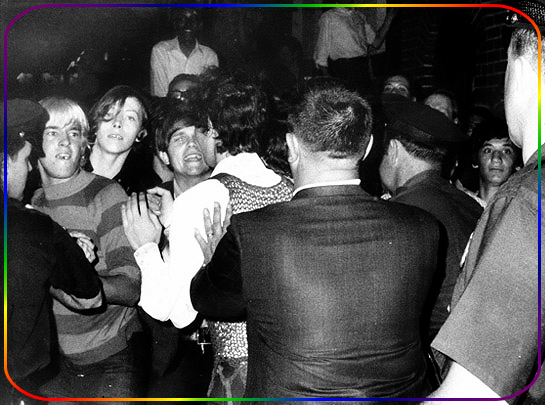
Although the LGBT Civil Rights Movement had been building for decades, many people mark the beginning with the Stonewall Riots that took place in the summer of 1969.  In the 1960s, bars & restaurants were prohibited from serving homosexuals, and those that were known to do so were often raided by the police.  The June 28, 1969 raid of the Stonewall Inn on Christopher Street was meant to be just another routine raid: line up the customers, check their ID, arrest those without ID or in drag, and back to business.

But this time the patrons fought back.  As the patrons of the bar were released, instead of dispersing as usual, they hung around.  More people gathered, and while the crowd initially stood by only mocking the police officers, the situation grew more hostile as the night went on.  The rioting began when one lesbian patron, who had been struggling with four police officers for about ten minutes, was hit on the head by one with a billy club.  It is said she turned to the crowd and yelled, "Why don't you guys do something?"

Eventually the Tactical Police Force (TPF) arrived to break the riots up.  It took them until 4am to break up the rioting and clear the streets that night.  Of the hundreds who were there, only 13 were arrested and four officers were injured, but many in the crowd were hospitalized, and the Stonewall Inn was destroyed.  The next night the protesters came back; this time, not just hustlers, drag queens, and homeless gay youth with nothing to lose, but curious onlookers, tourists, and "police provocateurs" added to the rioters numbers. 

Thousands of people crowded outside the bar, which had reopened, blocking the streets, terrifying passing cars & buses, and starting fires in trash cans.  The TPF was brought out again, and again took until 4am to clear the streets.  Due to rain, the rioting was intermittent over the next few days, flaring up when The Village Voice ran reports of the events which were unflattering to participants on both side.

The Stonewall Riots united the gay community to fight for LGBT Civil Rights; groups such as the Gay Liberation Front and Gay Activists Alliance were formed; and Gay Pride was celebrated for the first time on the one year anniversary (June 28, 1970).  The Stonewall bar is once again a popular gay night spot in NYC, attracting locals and tourists looking to pay tribute to a piece LGBT history.

~~

Also this month:

~ October is also National Bullying Prevention Month.

~ October 10th was Unity Day; wear orange to show your support and remind others about the importance of bullying prevention.

~ October 11th was National Coming Out Day when we celebrate coming out as gay, lesbian, bisexual, transgender or as an ally. See the Human Rights Campaign website for resources on coming out.

~ October 19th is Spirit Day; wear purple on this day to support LGBT youth & stand up against bullying.